
From Awareness to Conversion: Understanding the Digital Marketing Funnel
INTRODUCTION
A person may discover your business through Instagram, Google, YouTube, a blog, or an online advertisement. But discovering a brand does not always mean they are ready to buy. They may visit your website, explore your services, read reviews, compare different options, and take time before making a decision.
This is where the digital marketing funnel becomes important.
A digital marketing funnel helps businesses understand the journey a potential customer takes from discovering a brand to taking meaningful action. It also helps marketers create the right message and content for people at different stages of their decision-making process.
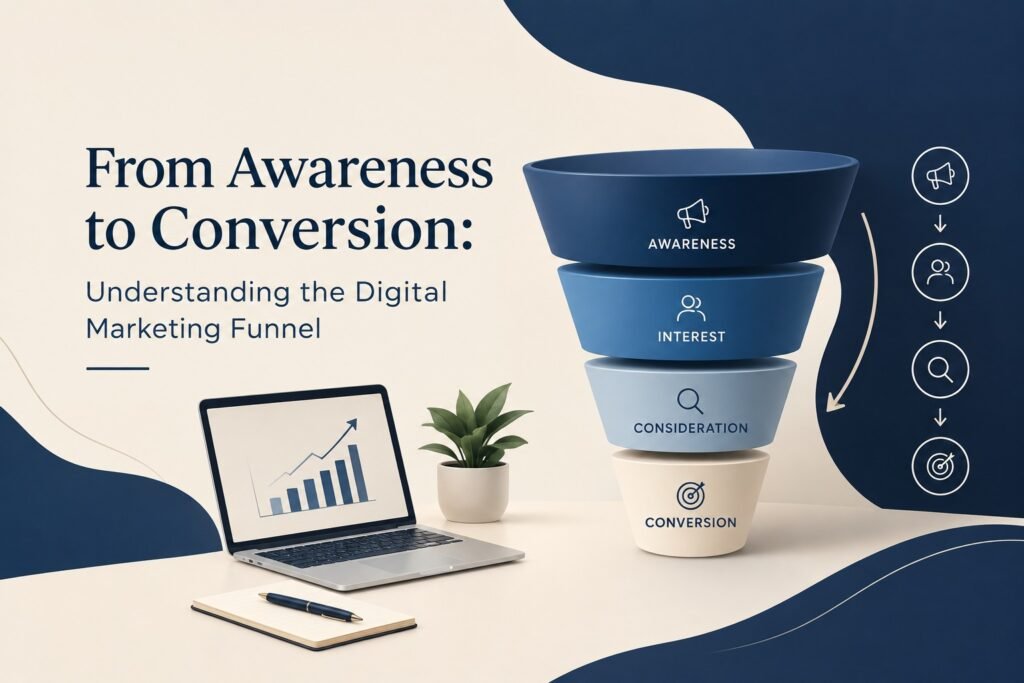
A simple digital marketing funnel can be understood through three key stages:
Awareness → Consideration → Conversion
Each stage has a different purpose. Understanding these stages can help businesses build a more focused digital marketing strategy and guide potential customers towards action.
What Is a Digital Marketing Funnel?
A digital marketing funnel is a framework that represents the different stages a person may go through before becoming a customer.
Not everyone who sees your Instagram post or visits your website will immediately purchase your product or service. Some people are discovering your brand for the first time, while others may already be comparing your business with competitors.
For example, someone looking for digital marketing services might follow this journey:
Discover an Instagram post → Visit the profile → Check the website → Explore services → Read testimonials → Compare options → Send an enquiry.
Every interaction can influence the person’s decision.
This is the basic concept of the digital marketing funnel.
1. Awareness: Helping People Discover Your Brand
The first stage is Awareness.
At this stage, people may not know that your business exists. They may not even be actively searching for the product or service you offer.
The main goal is to introduce your brand to the right audience and create initial interest.
Businesses can build awareness through:
- Social media posts and Reels
- SEO and Google search
- Blog articles
- YouTube videos
- Online advertising
- Educational content
- Influencer collaborations
- Guides and useful resources
For example, a fitness centre could publish an Instagram Reel titled “5 Simple Habits for a Healthier Lifestyle.”
Someone interested in fitness may come across the Reel and discover the fitness centre for the first time. They may not immediately become a customer, and that is normal.
At the awareness stage, the focus is on visibility, relevance, and initial interest.
The main objectives are:
- Increase brand visibility
- Reach the right audience
- Introduce your business
- Create initial interest
- Provide useful information
The key question at this stage is:
“How can we make the right people aware of our brand?”
2. Consideration: Helping People Evaluate Your Brand
Once people know about your brand, they may want to learn more.
This is the Consideration stage.
At this point, potential customers are no longer simply asking, “What is this brand?”
They are beginning to ask:
“Is this the right choice for me?”
They may visit your website, explore your services, check your social media profiles, read reviews, compare different businesses, or look at examples of previous work.
This is where trust and clarity become especially important.
Businesses can support the consideration stage through:
- Customer testimonials
- Case studies
- Portfolio examples
- FAQs
- Product demonstrations
- Detailed service information
- Educational blogs
- Comparison guides
- Customer reviews
For example, someone considering a digital marketing service may want to know what services you provide, how you work, what your process looks like, and how your service can support their business goals.
Providing clear and useful information helps potential customers understand your value and evaluate their options more confidently.
The focus is:
Build trust → Show value → Answer questions → Help people evaluate their options.
The key question at this stage is:
“Why should a potential customer consider our brand?”
3. Conversion: Turning Interest Into Action
The final stage is Conversion.
A conversion happens when a person takes the action a business wants them to take.
For an e-commerce business, this may mean purchasing a product. For a service-based business, it could be submitting an enquiry, requesting a quotation, or booking a consultation.
Common conversion actions include:
- Purchasing a product
- Booking a service
- Filling out a contact form
- Requesting a quote
- Sending a WhatsApp message
- Booking a consultation
- Signing up for a newsletter
- Registering for an event
At this stage, businesses should make the next step simple, clear, and convenient.
This is where a Call to Action (CTA) becomes important.
Examples include:
- Get Started
- Book a Consultation
- Request a Quote
- Shop Now
- Contact Us
- Learn More
- Schedule a Call
Imagine a visitor has already explored your services and decided they are interested. If they cannot easily find your contact details or understand what to do next, they may leave without taking action.
A clear CTA creates a direct path from interest to action.
A business website should also have:
- Simple navigation
- Clear service information
- Visible contact options
- Easy-to-complete forms
- Mobile-friendly design
- Strong trust signals
- Clear CTAs
The focus is:
Make the next step easy for the customer.
Why Is the Digital Marketing Funnel Important?
The funnel helps businesses understand what happens between first contact and customer action.
Without understanding the funnel, businesses may focus only on followers, likes, impressions, or website traffic. While these metrics can provide useful information, they do not always show whether people are moving towards becoming customers.
Businesses should also ask:
- Are the right people discovering our brand?
- Are visitors interested in our offer?
- Are they finding enough information?
- Do they trust our business?
- Are they taking action?
- Where are potential customers leaving the journey?
For example, if a website receives thousands of visitors but generates very few enquiries, the problem may not necessarily be a lack of traffic.
It could be caused by:
- Unclear messaging
- Weak CTAs
- Poor navigation
- Lack of trust signals
- Confusing service information
- A complicated enquiry process
Understanding the funnel helps businesses identify areas that may need improvement.
A Simple Example of the Full Funnel
Consider a local clothing brand.
Awareness:
The brand publishes an Instagram Reel showcasing its latest collection. A potential customer discovers the brand.
↓
Consideration:
The customer visits the profile, explores the website, checks product details, reads reviews, and looks at customer photos.
↓
Conversion:
The customer selects a product and completes the purchase.
This shows that digital marketing is not simply about creating one advertisement or one social media post. It is about creating a connected customer journey where each stage supports the next.
How to Build a Better Digital Marketing Funnel
A successful funnel begins with understanding the audience.
Businesses should identify:
- Who their customers are
- What they need
- What problems they face
- What influences their decisions
- Where they spend time online
Content should also match the customer’s stage.
At the Awareness stage, focus on content that attracts attention and introduces the brand.
At the Consideration stage, provide information that educates, answers questions, and builds trust.
At the Conversion stage, make the desired action clear and easy.
Businesses should also make trust visible through genuine reviews, testimonials, case studies, previous work, useful content, and transparent communication.
Finally, measure meaningful results such as website traffic, engagement, leads, enquiries, conversion rate, and sales. These insights can help identify what is working and where the customer journey can be improved.
Final Thoughts
The digital marketing funnel provides businesses with a practical way to understand the journey from first discovery to meaningful action.
It begins with Awareness, where potential customers discover your brand. It moves into Consideration, where they learn more, evaluate their options, and look for reasons to trust your business. Finally, Conversion is where interest turns into action.
The journey can be summarised simply:
Attract → Inform → Build Trust → Convert
Digital marketing is not only about getting people to notice your business. It is about creating a clear and valuable journey that helps the right audience understand your brand and take the next step.
When every stage is planned carefully, digital marketing efforts can work together to attract attention, build credibility, generate meaningful enquiries, and turn interest into action.
Because successful digital marketing is not just about being seen. It is about creating a journey that gives people a clear reason to engage and take the next step.